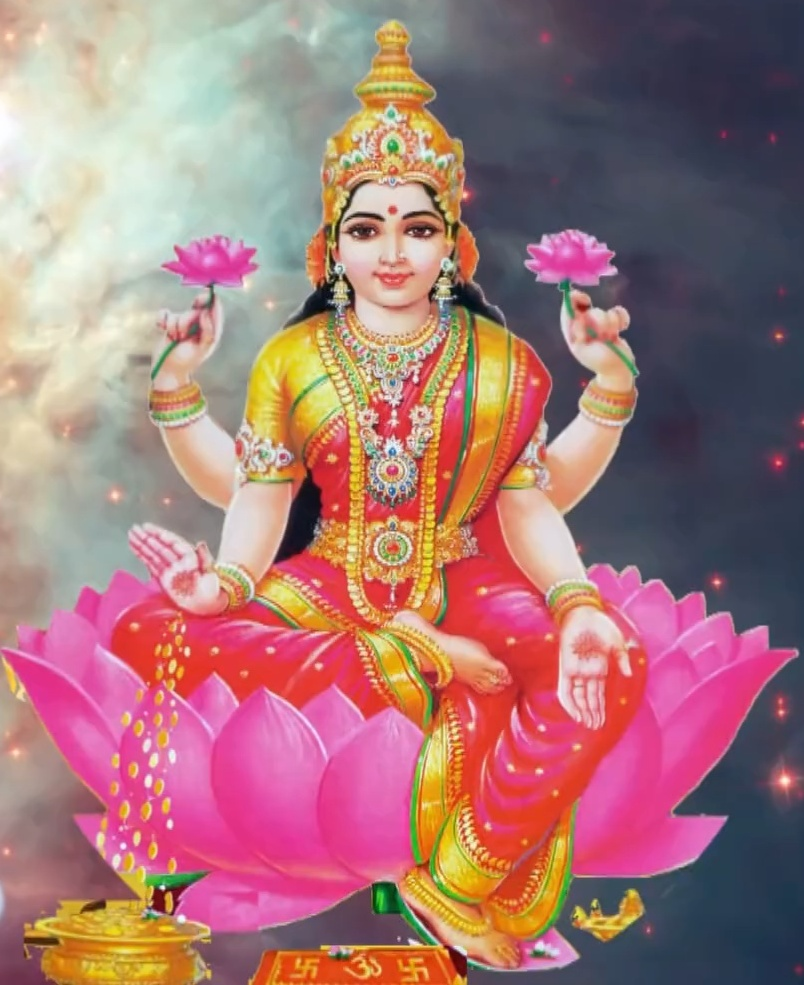
A couple of days ago, I happened to think of my mother whose name was Lakshmi. That led me to think of the lotus flower on which, per Indic mythopoesis, the Goddess Lakshmi is pictured.
The lotus grows from the mud in swamps or beneath ponds, suggesting how the noblest of things are often rooted in what may seem in superficial evaluations as base and lowly. This beautiful flower is always seen floating on the surface of water, surrounded by its wonderful leaves. It is pure white or pink, and sometimes even blue. Lotus petals open up with the rising sun and close again at dusk. The flower is unique in that its fruit and flower blossom at the same time. There is perhaps no other flower that symbolizes serenity and symmetry more beautifully than the lotus. It has a charm that captures any onlooker.
The surface of the lotus leaf is not perfectly smooth. It consists of innumerable tiny bumps which are not visible to the naked eye but can be seen through an electron-microscope. The leaf has a waxy substance which makes it hydrophobic: i.e. not clinging to water. So, the lotus leaf doesn’t become wet. This remarkable property of the lotus leaf captured the attention of ancient nature-observers, and the flower acquired cultural importance.
The beautiful lotus is represented in Egyptian hieroglyphics. In the Odyssey, we read about an island where people ate the lotus fruit; this made them forget all about the worries of the world. Homer described the juice of the lotus fruit as “divine and nectarous.”
The lotus has a special place in Indic culture. The sacred text Shri Vishnu Tattva states that the flower is associated with “truth from which emerge dharma and jñana.” The richness of the Sanskrit language and the ubiquitous role of the flower are reflected in the fact that there are more than a dozen different words for lotus in Sanskrit, such as padmam, pankajam, nalinam, aravindam, utpalam, nīraja, suka, ambhojam, mahotpalam, shatpatram, pankeruham, tāmaram, sārasam, rājīvam, kamalam and puṇḍarīkam (white lotus). Padma and kamala are its most popular names.
In mythic lore, the lotus is said to have emerged with the Goddess Lakshmi during the Churning of the Ocean. It is therefore an epithet for that Goddess of Prosperity. In a sacred text bearing the name Padma Purānam, we read that in primordial times the cosmos was a golden lotus. Vishnu is known as Padmanábha, because the cosmic lotus emerged from his navel (nábha). The Vishnu Purana says that in one of His incarnations Lakshmi came as Kamala, another name for lotus. Lakshmi is usually depicted on a pink lotus.
A dry variety of lotus is known as aravinda. There is a legend to the effect that once Vishnu was worshiping Shiva with lotuses. Towards the end, he fell short of one last flower, whereupon he plucked one of his eyes and offered it as a lotus. This earned Vishnu the epithet Aravindâksha: One with the lotus-eye.
In Hindu mysticism, one speaks of a miniature lotus within the human heart, and it is there that the soul resides. So we are asked to concentrate on the lotus in the heart’s core. This may be taken as a metaphor for saying that the ultimate in goodness is like the most beautiful thing in the world (lotus) and that it resides in the human heart.
A major posture in hathayoga is the padmāsana: the lotus posture. Buddha is often sculpted as meditating in this posture. A sacred Buddhist mantra is Om mani padme hum. The lotus symbolizes wisdom. The Dalai Lama explained: “Just as a lotus grows forth from mud but is not sullied by the faults of mud, so wisdom is capable of putting you in a situation of non-contradiction whereas there would be contradiction if you did not have wisdom.”
Water droplets roll on lotus leaves like little balls of mercury. Lotus leaves don’t get wet themselves. It is a common saying in the Hindu framework that our involvement with the world should be likewise: being part of it, and yet not getting attached to it. The simile is used in the Bhagavad Gita where Lord Krishna tells Arjuna (V.10) that a person who does his duty without attachment, surrendering the fruits of all actions to the Supreme, is unaffected by anything sinful, like a lotus leaf in water.
Some claim that lotus has curative properties because it has chemicals that “protect the heart and blood vessels.” Chemists have analyzed the molecular constituents of lotus, and detected apomorphine and nuciferine. Blue lotus is known to have a calming effect and is used in some electronic cigarettes: an instance of the descent from the sublime (spirituality) to the stimulant that is sometimes an aspect of science-based civilization.
Be that as it may, in no other culture is a flower given such symbolic, spiritual, mythic, and metaphysical significance as in the Indic. It was appropriate therefore that the lotus was chosen as the national flower when India became a modern nation in 1947.

 Spurts of Thought